Can the business case for HelloID be quantified?
Yes and no. Our solutions deliver significant benefits that are not always easy to quantify. While a data breach can lead to substantial fines and reputational damage, its true impact is difficult to predict. In contrast, the IT cost savings achieved through automated identity lifecycle management are measurable, as are additional savings from process automation and optimized license usage. In many cases, these tangible cost reductions alone are enough to build a strong business case.
How does automation make your IAM secure and compliant?
We ensure the platform adheres to the principle of least privilege. This is a fundamental pillar for compliance with information security standards such as ISO 27001 and the GDPR. To achieve this, we integrate our solutions with a business source system, often the HR system. The employee data recorded there, such as a person’s role or function, serves as the single source of truth. In the Role-Based Access Control (RBAC) framework, the applicable access rights for each role are defined unambiguously. Users receive access strictly on a need-to-know basis, and because every role change is processed immediately from the source system, our solutions are always up to date. For additional or temporary requests, required separation of duties and approval checks can be configured, while the system’s audit logs allow us to review all changes, actions, and recorded data at any time.
How does HelloID support a controlled migration from a legacy IAM platform?
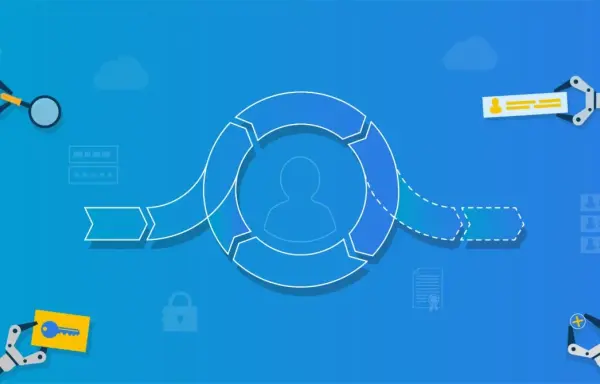
Because HelloID provides Identity-as-a-Service, no implementation is required; only configuration is needed. At a high level, we automate two areas: first, the identity lifecycle processes; and second, service processes, including requests for additional or temporary access rights. For the identity lifecycle, we connect HelloID to one or more source systems and the target systems, and configure the RBAC framework using Business Rules. We can start the migration in a controlled way with a single source system, a single target system, and a basic RBAC model. From there, we can gradually add more integrations and expand and refine the RBAC model. Service processes can be automated on a per-process basis. We can also start easily with so-called delegated forms and introduce fully automated self-service later.
We manage our own AD environment. Do we still need HelloID?
Yes. For core IAM functions, authentication and authorization, organizations often use their own AD environment today. What is missing is a full management solution that can automatically and timely assign the right access to everyone in a large organization with hundreds of users and dozens of applications. HelloID covers that need. AD provides the technical layer for authentication and authorization. HelloID handles the broader integration and management. In addition, our flexible Access Management module, which includes extensive Single Sign-On and Multifactor Authentication, often provides the required workarounds during migration and merger projects. It is also not always necessary for every user group to use the comprehensive, and therefore more expensive, Microsoft licenses. For those users, HelloID SSO and MFA Access Management, combined with a relatively low-cost E1 license, is often sufficient.