







USE CASE
Enhanced Organizational Security
Role-based Identity and Access Management that follows the least privilege principle and serves as the cornerstone of a Zero Trust architecture.

CHALLENGE
How to migrate to a future-ready security approach
Traditional enterprise security assumes defined security perimeters. The focus is on strong access control to the corporate network, but once inside, connected users and devices are assumed to be trusted. As remote work becomes standard and not only employees but also contractors, customers, and partners require access, a fundamentally different security approach is needed.
REQUIREMENTS
Features
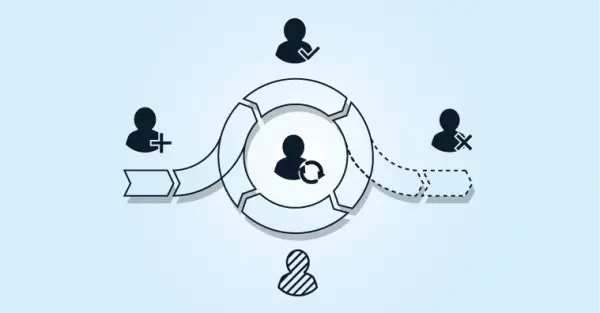
Identity Lifecycle Management
Process changes from source systems, such as an HR system, and automatically create, modify, or revoke user accounts and permissions based on them.

Role-Based Access Control (RBAC)
Assign and revoke accounts and permissions based on roles. Each role defines which accounts and permissions are required.

Self-Service & Workflows
Automate handling of access requests and other user requests.

Helpdesk Delegation
Delegation and standardized handling of IT tasks through forms for non- or semi-skilled help desk staff and key users.
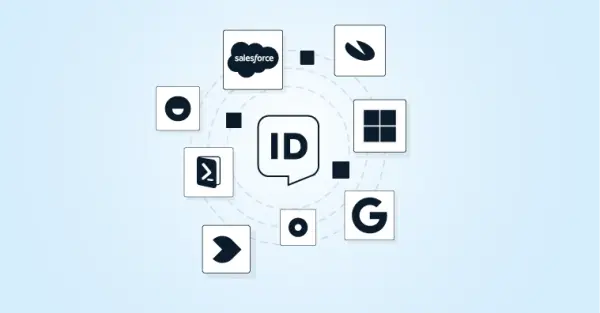
Open Integration
Support for open standards together with an extensive connector catalog to integrate various source and target systems.

Single Sign-On
User-friendly and secure access to all applications through one portal, one username, and one password.

Multifactor Authentication
Enforce additional security by applying multiple authentication factors and conditional access policies.
HOW IT WORKS
How we deliver Zero Trust ready Identity and Access Management
7 steps, each configurable with low code or no code
Source system: Integrate HelloID with source systems such as HR, SIS, and scheduling systems. Changes in the source data are automatically available in HelloID.
People: Normalize person and role data from source systems into a common representation within HelloID using an identity vault.
Business Rules: Define rules that determine which roles receive which types of accounts and access rights, and under which conditions.
Target systems: Connect HelloID to on-premises and cloud applications. This can be implemented incrementally per application.
Service processes: Automate processes, including online approval flows and activation in target systems. This can be executed per process as a separate step.
Access management: In conjunction with, for example, Active Directory, configure access procedures such as Single Sign-On and Multi-Factor Authentication.
Reporting and auditing: Configure standard and customer-specific reports and monitoring functions for analysis and audits.