







Principle of Least Privilege (PoLP)
What is the Principle of Least Privilege?
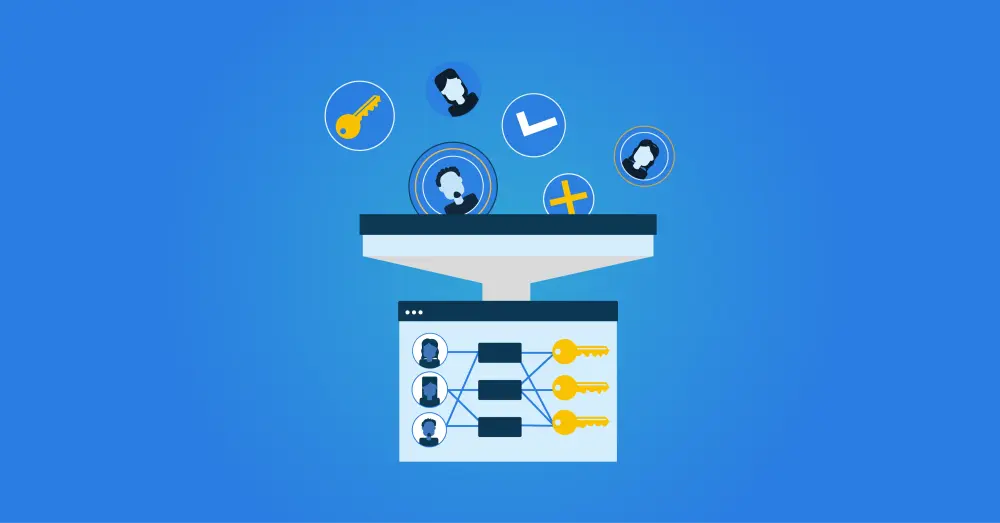
The Principle of Least Privilege (PoLP) means that users receive access rights only to the applications and data they need to perform their tasks. Users, therefore, do not receive more rights than strictly necessary. The Principle of Least Privilege is not only applicable to access security for human users. The principle can also be applied between applications.
Examples by Industry
What does the Principle of Least Privilege look like in practice? Below are a few concrete examples:
In education, access rights can be organized so that each teacher has access only to the personal data and academic results of the students they teach.
In a case management system within, for example, a municipality, you can set access rights so that each user has access only to the case files for which that official is responsible.
Within healthcare organizations, administrative staff may have access only to administrative data, while clinical staff also have access to medical data for the patients they are responsible for.
In these examples, you determine, for each user, based on their role and responsibilities, which applications and data are required. You block all other systems and data for that user.
Why is the Principle of Least Privilege Important?
Its importance lies in two closely related aspects:
First, it limits damage if an unauthorized person gains access by using an employee's credentials. Someone may gain access to your IT systems, but because of least privilege, they cannot access everything. For example, if the password of an administrative employee at a healthcare organization is stolen, the medical data remains secure.
You also do not want legitimate users to access everything by default. Under privacy guidelines, employees may view only the personal data they need to do their jobs. In a hospital, for example, clinical staff may not view patients' records that they are not treating.
What is the Difference Between the Principle of Least Privilege and Privacy by Design?
With the Principle of Least Privilege, you ensure that users have access only to the personal data they need for their work. It is one of the principles to meet privacy guidelines. There are, however, other mandatory privacy controls. You must automatically log all access attempts and record how and when people give consent to the use of their personal data. You must also implement measures to ensure that personal data is removed promptly when no longer needed.
To meet all of those privacy requirements, IT systems and processes must be designed so that privacy and data protection are considered from initial design through implementation. This means not a few isolated or even reactive changes added later, but a solution architecture in which privacy controls are embedded by design. This is called Privacy by Design.
Both principles, the Principle of Least Privilege and Privacy by Design, are important for privacy, although they serve different purposes. Privacy by Design focuses on making your system and process design fully privacy compliant; least privilege is one of the principles to consider within that approach.
Benefits of the Principle of Least Privilege
The benefits of the Principle of Least Privilege are clear. It limits damage if credentials fall into the wrong hands. It also prevents intentional or unintentional disclosure of personal data by employees. Least privilege helps you prevent data breaches.
Data breaches, the unwanted exposure or distribution of personal data, present a major risk for many organizations. They can lead to significant claims, especially if it appears that the organization did not do everything possible to prevent them. Potential fines are also high when there has been insufficient investment in security measures. Your reputation will suffer if you are demonstrably negligent with personal data. Investing in least privilege measures will pay off.
How HelloID Complies with the Principle of Least Privilege
Access security starts with authentication and authorization. Authentication verifies a user's identity, for example, with a username and password. Authorization is the next step and focuses on granting the correct access rights. As an organization grows in users and applications, access management quickly becomes complex. You solve this by automating account creation and access rights with an Identity and Access Management (IAM) system. By making the right choices, you can ensure that account management fully complies with least privilege principles.
HelloID supports least privilege with multiple capabilities:
Provisioning of accounts and access rights can be managed based on employees' roles, job functions, departments, and other attributes as recorded in the HR system. HelloID always has the most up-to-date information through an integration with the HR system.
All access rights are issued in accordance with business rules. These define which access rights are required for specific attribute combinations. Each employee, therefore, receives only the strictly necessary access.
Thanks to the direct integration between HelloID and the HR system, data is always up to date. If someone changes roles, their access rights are automatically updated. When someone leaves the organization, their account is automatically disabled.
If someone requires additional access rights for a specific project, HelloID automates the request process, verification, and manager approval, and can also ensure that such rights are automatically revoked on time.
Within HelloID, the Principle of Least Privilege is fully enforced through an Attribute-Based Access Control framework. It is easy to configure using flexible business rules, and those same rules make it simple to adjust the ABAC framework when needed.
Related Articles
- How Zero Trust Helps Organizations Reduce Cyber Risks
- Not IAM Compliant Yet?
- Smarter information and access security with AI
- Data Breach Report: 5 Key Takeaways
- Stopping Privilege Creep in its Tracks
- Azure Active Directory: The Dangers of Improper User Provisioning and RBAC Mismanagement
- How Do I Write a Business Case for IAM
- How to Prevent External Access to Key Files
- 4 Ways an IAM Solution Can Benefit Healthcare Organizations
- Why Do You Need an IAM Solution?