







SAML vs OAuth vs OpenID Connect
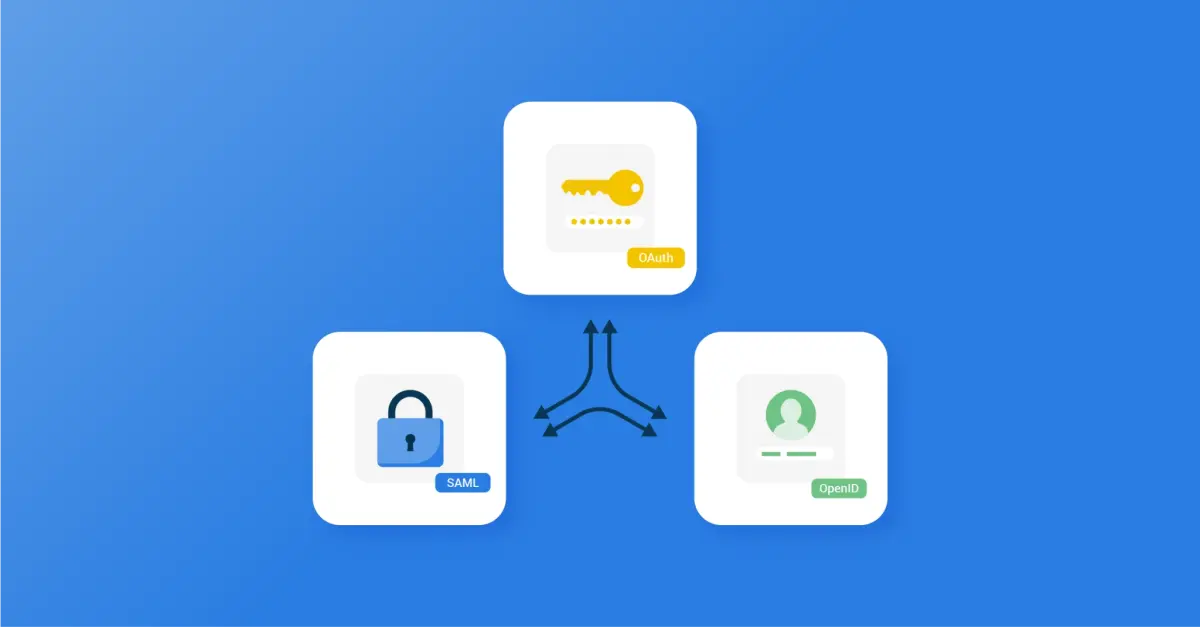
SAML and OAuth are two popular standards for granting users access to applications, services, and data sources without requiring them to remember numerous passwords. OpenID Connect is an additional layer on top of OAuth that focuses specifically on authentication. What is the difference between SAML, OAuth, and OpenID Connect? And what are the similarities between these three protocols? We answer these questions in this article.
What is SAML?
SAML stands for Security Assertion Markup Language. It is one of the most widely used standards for exchanging authentication data. The standard plays a crucial role in delivering secure Single Sign-On (SSO), enabling users to sign in to a wide range of applications via a portal using a single set of credentials. This is possible because SAML providers communicate with each other. We distinguish between identity providers (IdP) and service providers (SP). The SP receives from the IdP all information required to verify the user’s identity and access rights.
What is OAuth?
OAuth is short for Open Authorization. It is a standard, like SAML, that enables access to multiple applications and services without creating a new account each time. You sign in to the applications and services you want to use with an account that supports OAuth. Examples include email accounts from major email providers. You therefore do not need to create separate accounts for every application or service. OAuth improves usability by enabling quick and easy access.
What is OpenID Connect?
OpenID Connect is an authentication layer built on top of OAuth. It adds an identity layer to OAuth. Applications can therefore not only check whether a user is allowed to access, but also verify the user’s identity. OpenID Connect exchanges identity information securely using JSON Web Tokens. The protocol enables users to sign in to multiple services with a single account, while allowing service providers to verify the user’s identity.
What are the Similarities Between SAML, OAuth, and OpenID Connect?
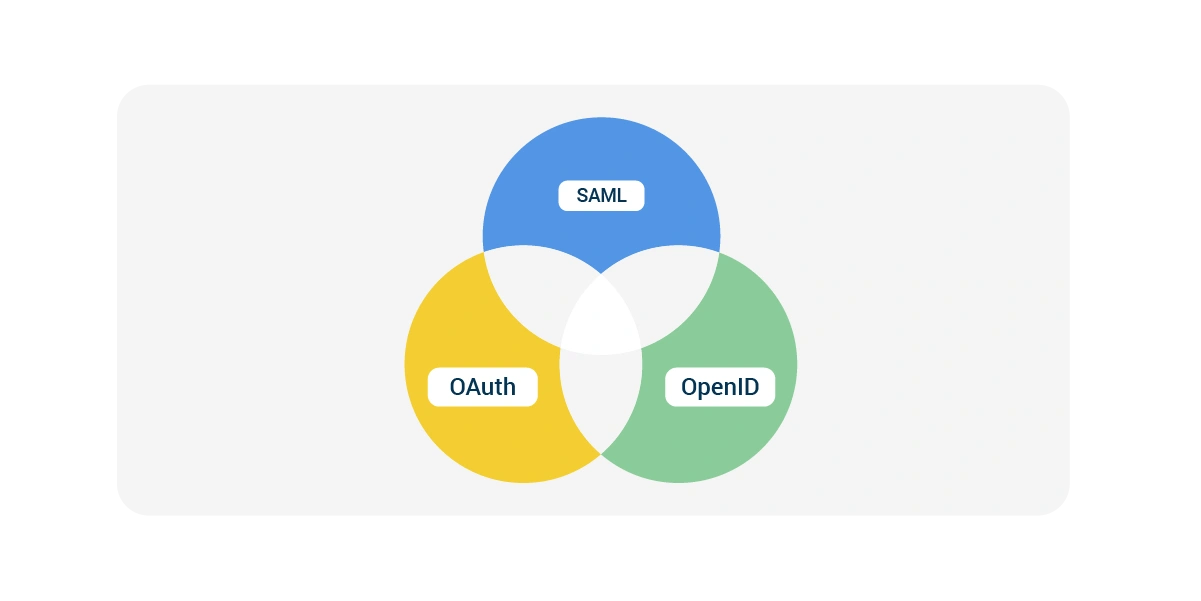
SAML, OAuth, and OpenID Connect share important similarities. All three standards provide users access to applications and services without requiring individual passwords. This provides several benefits:
Users need to remember fewer credentials and are less likely to forget passwords.
Users can adopt stronger passwords because they need to remember fewer different passwords.
The user experience improves because users gain access to the systems they need with a single set of credentials.
Additionally, each process checks whether users actually have access to the application, service, or resource they attempt to reach. In all cases, only authorized users are admitted.
What is the Difference Between SAML, OAuth, and OpenID Connect?
Although SAML and OAuth share many similarities, there are important differences. The main differences are:
With SAML, the user signs in to an IdP and then gains seamless access to multiple applications and services without encountering additional login prompts. This is not the case with OAuth; users must sign in to individual applications and services themselves using an account that supports OAuth. With OpenID Connect, users sign in once to an IdP and then, thanks to JSON Web Tokens, gain access to multiple applications without having to sign in again.
SAML communicates through XML messages, which allow an IdP to exchange confidential information with SPs. In practice, this means the SP can verify your identity without you providing information directly. OAuth uses access tokens. In this case, an application only knows that you are allowed access, but it cannot verify who you are. OpenID Connect uses JSON Web Tokens for this purpose, which contain both authorization and authentication information.
Accordingly, SAML is designed for both authentication and authorization, while OAuth focuses solely on authorization. In some cases, OpenID Connect (OIDC) is used as an additional layer on top of OAuth, which enables identity verification.
SAML provides strong security because the protocol allows verification of user identities, although implementation can be relatively complex due to its XML-based communication. OAuth is easier to implement, but does not offer user identity verification. OpenID Connect combines OAuth’s implementation simplicity with the ability to verify user identities.
Which Protocol Should You Choose?
Which protocol is most suitable for your organization depends on your specific needs. SAML is ideal for enterprise environments where you want to provide a seamless SSO experience. If authorization and access via APIs are critical, OAuth is often a good choice. OpenID Connect is well-suited for situations where you need both authentication and authorization.
Want to learn more about SAML? In our knowledge base, you will find more information about this standard. Want to read more about OAuth and how it combines with OIDC?
Read More Here