







9 best practices for identity and access management (IAM)
With identity and access management (IAM) you can configure access to applications, services, and data sources in detail. Several best practices help you optimize identity and access management and protect your organization. In this article we outline the most important IAM best practices.

1. Be deliberate about data access
Organizations typically hold valuable data that must be kept secure. Unfortunately, we still often see organizations grant employees broad access to data. This is risky, since you lose control over who can access your data. A best practice is to be deliberate about data access. First, map the data your organization stores and identify which information is sensitive. Then determine which users must have access to this sensitive data and restrict access to the minimum required. This reduces the risk of data breaches and keeps your information safe.

2. Adopt a Zero Trust approach
Zero Trust is a security approach in which the trust granted to users after authentication is minimized. In practice this means you continuously verify user identities and you do not inherently trust any user, device, or application. You can combine Zero Trust with Multi-Factor Authentication (MFA) and Single Sign-On (SSO) to further increase security and usability. Closely related to Zero Trust is least privilege. You continuously review the access rights users require. You restrict access to the minimum necessary, without hindering users in their daily activities. For least privilege you can use roles that you assign to users and derive the rights they need from those roles. If an unauthorized person gains access to an employee’s account, least privilege limits impact and damage.
3. Strengthen security with SSO and MFA
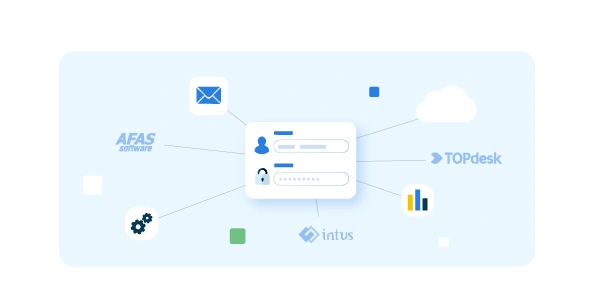
Using strong passwords is important for keeping systems, applications, and data secure. Users should use a unique and sufficiently complex password and store it securely. With SSO you reduce this burden and mitigate related risks. SSO gives users access to all applications, services, and data sources they need with one set of credentials. You can also implement MFA. With MFA, users authenticate not only with their username and password, but also with a second factor. This can be a code delivered by SMS, email, or an authenticator app such as HelloID Authenticator. MFA significantly increases digital security. If a username and password are leaked, an unauthorized party still cannot gain access because the second factor is missing.

4. Use Role-Based Access Control and Attribute-Based Access Control
Human actions are error-prone. A best practice is to automate the assignment of authorizations and permissions. Role-Based Access Control and Attribute-Based Access Control help with this. You make the user’s role and attributes the basis for assigning authorizations and permissions. For example, you ensure that all users in Finance or Sales receive the same rights. This prevents human error and simplifies configuring access for new users.
5. Use logs to increase insight
Logs are indispensable for IAM. They allow you to demonstrate compliance with laws and regulations in detail and simplify audits. You can also see exactly why a specific user was granted certain rights. This provides deep insight and ensures you stay in full control.
6. Develop an incident response plan
Although you take every measure to keep identities and access rights secure, incidents can still occur. A disgruntled employee may abuse access to systems and data sources, or attackers may exploit vulnerabilities to access a user account. Develop an incident response plan specifically tailored to IAM. This prepares you to act quickly and effectively during security incidents.

7. Clean up your processes
If you do not have an IAM solution or you use an outdated system, it is likely that not all joiner, mover, and leaver processes are configured optimally. Consider processes that are no longer needed or no longer function properly due to changes in your IT landscape. A key security measure is to regularly clean up your processes.

8. Focus on physical and digital access security
Do not focus only on securing access to business applications, data sources, and other systems. Address other forms of access security as well. This includes access to your office building and individual rooms within it. Even if digital access is configured optimally, unauthorized physical access to systems can put your data at risk.
9. Embrace certifications and standards
A broad range of data security certifications and standards are available. Consider ISO 27001 for information security, Network and Information Security Directive 2 (NIS2), Baseline Information Security for Government (BIO), and NEN 7510 for information security in healthcare. Meeting these certifications and standards not only demonstrates to customers, users, and partners that your security posture is in order, it also helps elevate your digital security. Review which certifications and standards are relevant to your organization and sector and take advantage of them.
Want to learn more?
Want to learn more about IAM? Read the article in our knowledge base. Ready to get started with IAM? In a series of articles we help you get started.