








On-premises vs cloud
In recent years, more and more organizations have replaced their on-premises systems with cloud solutions. Others are currently conducting a cost-benefit analysis of on-premises vs cloud, or they have already scheduled such a cloud migration.
The shift to the cloud is understandable. On-premises means organizations use their own locally installed computer systems to process and store their data. This makes your automation complex and costly. With cloud solutions, the software runs on remote servers in a data center managed by a cloud provider. End users can access the software and data online with ease, and because multiple organizations share the same software and facilities, it is simpler and more cost-effective. A well-known cloud example is Microsoft 365.
The cloud is popular in sectors such as healthcare and education, and even a more cautious sector like government now follows an active cloud policy. Popularity does not mean that a migration from an on-premises environment is always straightforward. Cloud solutions introduce significant challenges. Cloud security usually ranks first: How can you securely store, process, and share your data in the cloud? This blog examines that in more detail.

The importance of cloud security
Cloud security concerns the reliability, integrity, and availability of your cloud applications and especially all data you process, store, and manage in the cloud environment. This requires safeguards such as malware detection, data encryption, authentication, and authorization. It also requires active monitoring of access attempts and logging of all actions in the cloud.
The focus on a secure cloud is logical as well. A public cloud solution is shared with multiple organizations and is directly accessible via the internet. It is sensible to scrutinize the security measures of a cloud provider and platform. At the same time, we know that an on-premises platform is also becoming harder to secure. While cloud providers often have the scale to invest in their digital security, that is often a relatively high cost item in on-premises environments. Even if on-premises software feels safer, with your own servers, network, and firewalls, you also want to provide users, customers, and partners with direct online access today. On-premises solutions often appear safer than they are.
It is time to dive deeper and review what is required to organize information security in the cloud.
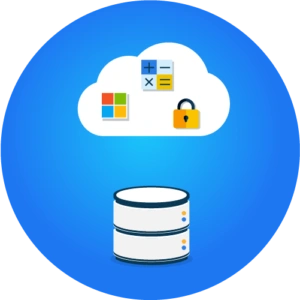
Information security in the cloud
In the cloud, customers share a common platform. The cloud provider must manage and encrypt customer data so that each customer can only view and use its own organizational data. That is only the first step in a longer list of required security measures. Here are some examples:
Secure user access: In addition to your own employees, you may also want to grant access to contractors and customers. Users log in from many locations and with different devices. Only with Identity and Access Management (IAM) systems can you keep access security manageable. In the next section, we explain the importance of a modern IAM for a secure cloud environment in more detail.
Secure cloud integrations: Many cloud applications are interconnected. Unlike a defined on-premises environment, that communication takes place directly over the internet. These interfaces must therefore be protected. This requires a zero-trust approach, where every communication session between cloud applications is always verified.
Prevent data breaches: Modern cloud applications make sharing information online very easy. Mistakes are easy to make, and even a well-intentioned user can inadvertently cause a data breach With smart Information Protection measures, you can label confidential data and detect and block unwanted sharing. We provide some examples in our blog on data breaches.
Cloud compliance and certification: The safest cloud storage requires more than technical measures. You primarily depend on the professionalism and expertise of your service provider. They must install and manage your applications and data correctly. Ensure clear agreements about security, including reporting and audit options. Always work with a provider that is at least ISO 27001 certified and can present a SOC 2 attestation.
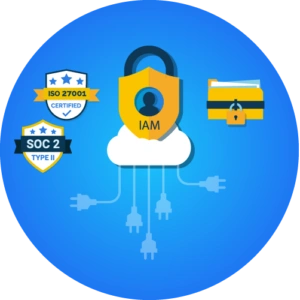
Identity and Access Management for cloud security
As noted, a modern IAM is essential to keep access security manageable in cloud environments. Here are some examples:
Authentication and authorization for your cloud services
Access security begins with verifying users, usually with a username and password. After authentication, a person is authorized for the required applications and data. Cloud providers provide this through their own Identity Provider, but advanced IAM platforms offer additional access management features to make this access control even more flexible.
Automated cloud provisioning and access management
The issuance and administration of user accounts and access rights has traditionally been a manual IT process. A manager or HR staff member submits a request for an account and access rights, and then an IT support staff member processes that request in the required systems. This is not only cumbersome and costly, it also often leads to errors and issues. Because people regularly change roles, they sometimes unintentionally accumulate more and more cloud access rights and become a risk to your information security. When someone leaves the organization, accounts sometimes remain active unintentionally as well. A modern IAM platform automatically synchronizes all accounts and access rights with data in source systems, often the HR system. Thanks to Role Based Access Control, the necessary privileges are defined with business rules for each user role. The issuance of non-standard access rights is streamlined as well. The relevant manager or managers are automatically asked online for approval, and the rights are terminated on time. This ensures that everyone has access to your cloud data only on a need-to-know basis.
Compliant cloud security
If you store personal data in the cloud, it is important not only to secure the data properly, but also to be able to demonstrate this at any time. If there is a cloud security breach, it is important to have an audit trail immediately to resolve the issue, inform customers, and prevent recurrence. A cloud-based IAM such as HelloID therefore logs all changes in the systems. All cloud access attempts by users are automatically logged as well.
Want to learn more about your cloud security?
Many organizations already rely largely on the cloud. Others compare on-premises vs cloud options or they are currently planning the migration of their existing on-premises IT landscape. In the cloud, information security is a serious focus area. With the right security controls and a professional, certified cloud partner, these challenges are very manageable today. Want to learn more about your access security in the cloud? Contact our sales department.