







USE CASE
Promoting Operational Efficiency
An efficient operation is enabled by centralized, consistent, and automated management of user accounts and access rights.

CHALLENGE
How do you prevent access management from hindering your operations?
Digitalization is a top priority for many organizations. In addition to general software suites such as Microsoft Office, specialized and advanced solutions are often used for specific business processes, such as EHR and scheduling systems. Such point solutions often have their own account structures and access methods, and as long as those systems must be managed separately, this creates a barrier to streamlining operational processes.
REQUIREMENTS
Capabilities
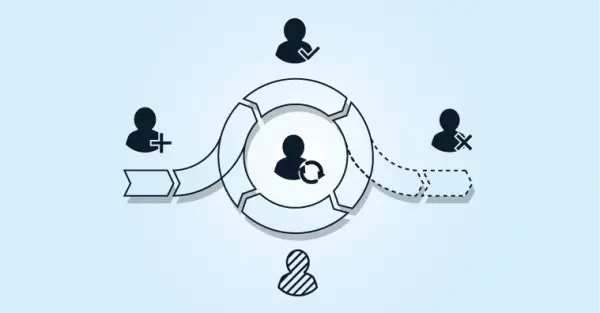
Identity Lifecycle Management
Process changes from source systems, such as an HR system, and automatically create, modify, or revoke user accounts and access rights accordingly.

Role-Based Access Control (RBAC)
Assign and revoke accounts and rights based on roles. For each role, the required accounts and rights are defined.

Self-Service & Workflows
Automated handling of requests for access rights and other user requests.

Helpdesk Delegation
Delegation and consistent handling of IT tasks through forms for (non/semi-skilled) help desk staff and key users.
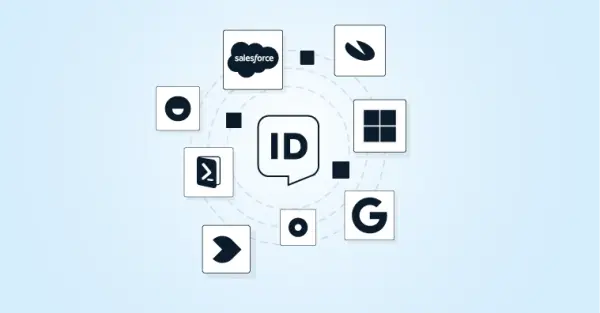
Open Integration
Support for open standards, together with an extensive connector catalog for integrating various source and target systems.

Single Sign-On
User-friendly and secure access to all applications through one portal, one username, and one password.

Multifactor Authentication
Enforce additional security by applying multiple authentication factors and conditional access rules.
HOW IT WORKS
How We Implement Efficient Account and Access Management
7 steps that can each be configured with low-code or no-code
Source System: Integrate HelloID with source systems such as HR, SIS, and/or scheduling systems. Changes to the source data are automatically available in HelloID.
People: Convert data about people and roles from source systems into a common representation within HelloID using an identity vault.
Business Rules: Set rules that determine which roles receive which types of accounts and access rights, and under what conditions.
Target Systems: Connect HelloID to on-prem and/or cloud applications. This can be done step by step per application.
Service Processes: Automate processes, including online approval flows and activation in target systems. This can be implemented per process as a separate step.
Access Management: In conjunction with, for example, Active Directory, define access procedures such as Single Sign-On (SSO) and Multifactor Authentication (MFA).
Reporting and Auditing: Configure standard and customer-specific reports and monitoring functions for analysis and audits.